
Common House Spiders
Identifying Common House Spiders in Maine
The common house spider (Parasteatoda tepidariorum) is one of the spiders Maine homeowners often find living indoors. These small spiders are especially likely to build webs in quiet, protected areas where insects are available for food.
Common house spiders are not known for aggressive behavior and are generally considered nuisance pests rather than a serious threat. For many homeowners, the bigger concern is the repeated appearance of spider webs in corners, basements, garages, windows, and other parts of the home.
At Advanced Pest Solutions, we help homeowners throughout Central and Coastal Maine reduce spider activity and the insects that attract spiders indoors.
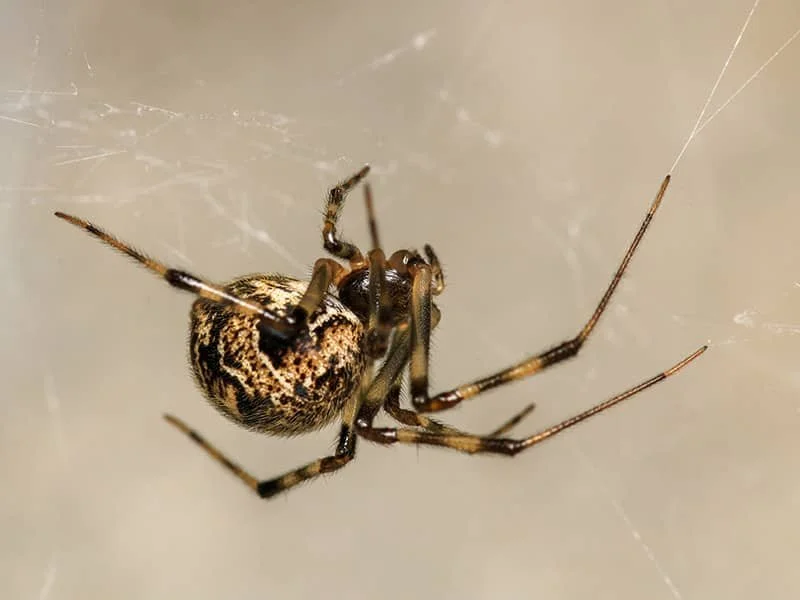
What Do Common House Spiders Look Like?
Common house spiders are relatively small and can vary somewhat in color and markings.
Typical characteristics include:
Small, rounded abdomen
Brown, tan, gray, or yellowish coloring
Darker mottled or patterned markings
Long, slender legs
Females that are generally larger and more noticeable than males
Body length usually less than ¼ inch, not including the legs
Their coloring can vary enough that appearance alone is not always the easiest way to identify them. The type of web they build and where that web is located can provide additional clues. Maine is also home to many other spider species, so identifying a spider requires considering its appearance, web, and location rather than assuming every indoor spider is a common house spider.
What Do Common House Spider Webs Look Like?
Common house spiders build irregular, tangled webs rather than the symmetrical circular webs people often associate with outdoor spiders.
These messy-looking webs are often described as cobwebs, especially after they have been abandoned and begin collecting dust.
A common house spider may leave an older web and build another nearby, resulting in several strands of webbing accumulating in the same area of a home over time.
Where Do Common House Spiders Build Webs?
Common house spiders prefer quiet, protected spots where insects regularly pass through.
Their webs are often found in:
Basement ceilings and floor joists
Window frames and upper wall corners
Garages and utility rooms
Attics and crawl spaces
Storage areas
Sheds and outbuildings
Areas near exterior lights, doors, or windows
Web placement is closely tied to food. Flies, moths, mosquitoes, small beetles, and other insects provide prey, so spiders often settle near areas where those pests enter or gather.
How Common House Spider Activity Changes With the Seasons
Spring
As temperatures rise and insect activity increases, spiders have more opportunities to feed both indoors and outside. Homeowners may begin noticing fresh webbing around windows, garages, basements, and other protected areas.
Summer
Summer provides abundant insect prey. Common house spiders may remain active inside, while outdoor spider populations also increase around buildings, porches, and landscaping.
Fall
As temperatures cool, spiders and the insects they feed on may move toward protected areas around homes. Indoor spider activity can become more noticeable in basements, garages, utility areas, and other sheltered spaces.
Winter
Common house spiders that are already indoors can remain active in heated or protected parts of a home. Activity may be less noticeable when insect prey is limited, but spiders do not necessarily disappear during a Maine winter.
Are Common House Spiders Dangerous?
Common house spiders are not considered dangerous to people.
Like most spiders, they have venom that helps them subdue prey, but bites are uncommon and usually occur only when a spider is trapped against the skin or handled.
For most homeowners, the concern is nuisance activity rather than a medical threat. Webbing, egg sacs, and repeated spider sightings are typically the reasons people want them removed.
Why Do Cobwebs Keep Coming Back?
Common house spiders may abandon an old web and construct another nearby, while other spiders can move into the same favorable area. Older webbing also collects dust, which makes abandoned webs increasingly noticeable.
Repeated cobwebs often mean the location continues to offer both shelter and insect prey. Removing old webbing improves appearance, but reducing the insects that spiders feed on is usually more important for discouraging spiders from building webs in the first place.
How to Reduce Common House Spiders Around Your Home
Reducing spider activity is often less about targeting spiders directly and more about making the home less attractive to both spiders and their prey.
Helpful steps include:
Remove old webbing from corners and storage areas
Seal gaps around windows and doors
Repair damaged screens
Reduce clutter in basements, garages, and storage spaces
Keep stored items organized and off the floor when practical
Limit unnecessary exterior lighting near doors and windows
Address insect activity around the home
Trim vegetation that touches the structure
Check around utility penetrations and other exterior openings
Because spiders follow their food supply, reducing indoor insect activity can make a meaningful difference in how many spiders establish themselves inside.
Common House Spider Control in Maine
Advanced Pest Solutions takes a broader approach to spider problems by addressing both spider activity and conditions around the home that support it.
Our technicians evaluate where spiders are building webs, look for conditions that may be contributing to insect activity, and treat areas with concentrated spider activity.
Common house spiders are covered under our residential pest control plans along with other common household pests. Ongoing service helps prevent insect and spider activity around the home year-round.
Contact Advanced Pest Solutions to learn more about our residential pest control plans.
Common House Spider FAQs
Are common house spiders the same as cellar spiders?
No. Common house spiders and cellar spiders are different species. Cellar spiders have much longer, thinner legs and are often found hanging upside down in loose webs in basements, garages, and similar areas.
Why do I keep finding spiders near my windows?
Windows attract many flying insects because of the light and warmth. Spiders may build webs nearby because these areas provide a reliable food supply.
Do common house spiders make egg sacs indoors?
Yes. Female common house spiders can produce egg sacs within their webs. These sacs may remain suspended in the web until the young spiders hatch.